By Ms.Coco Ho
A breakable ceramic mold can release a complex casting, but the wax pattern still has to be made.
Investment casting undercuts are often presented as straightforward because the ceramic mold is expendable. That statement leaves out the pattern stage. An injected wax pattern normally comes from reusable tooling, and a feature that locks into that tool needs a deliberate solution. Review wax release separately from metal release before calling an undercut easy to manufacture.
Contents
Two release problems, not one
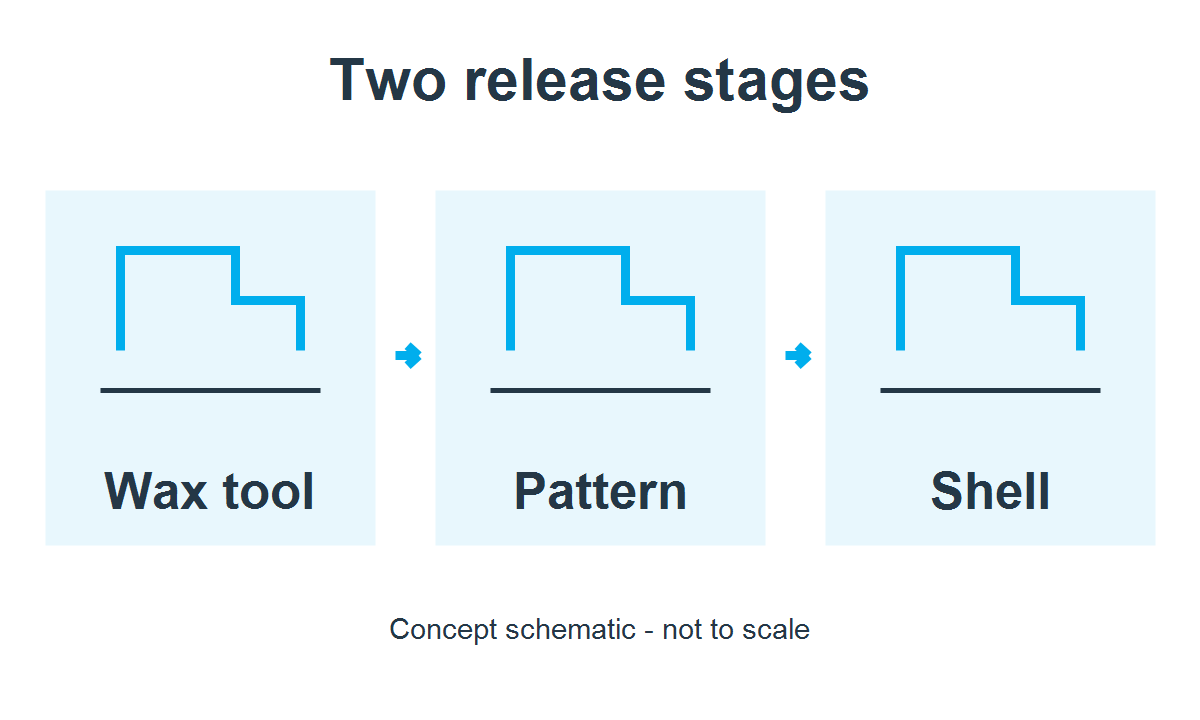
After pouring and cooling, the ceramic mold can be broken away from the metal. This permits forms that would be difficult to release from a rigid permanent metal mold. Earlier in the route, however, the wax pattern must be removed from its tool while retaining the required shape. The two stages impose different constraints.
Consider a flange with a hook-shaped return. The final metal may release when the shell is removed, yet the return can lock the wax into a simple two-part tool. The manufacturing proposal must explain the pattern-making method. Ignoring that stage can produce a quotation that appears simple but later requires tooling changes or added handwork.
Review possible pattern-making solutions
Depending on the geometry, a route may use movable tool elements, inserts, assembled wax sections or another suitable pattern method. Each introduces its own controls. More joints may create alignment or seam concerns; movable elements need repeatable location and release. The correct choice depends on access, quantity and functional requirements.
Do not assume that a fragile wax pattern can be flexed out indefinitely without distortion. A pattern that survives removal may still lose the dimensional relationship that matters on the metal part. Ask how release is achieved and which features are checked afterward. Pattern survival and pattern accuracy are separate questions.
| Review point | Evidence to request |
|---|---|
| Wax release | Tool movement, joints and post-release geometry |
| Metal release | Expendable shell removal and access |
| Commercial route | Tool cost plus repeat handling and inspection |
Keep internal features and core removal visible
An undercut can also create a sheltered ceramic region or an internal feature that is difficult to clean. Solving the wax tool does not establish that the finished casting can be cleared of ceramic. Review shell or core access and the final inspection method as part of the same design discussion.
A feature that cannot be seen or reached may still be feasible, but the supplier should identify an appropriate verification route. Avoid accepting an uninspectable critical surface merely because the process can form it. The delivered function depends on cleanliness, dimensions and material condition, not just geometric possibility.
Compare tooling complexity with a design alternative
A modest change in return angle, opening size or feature position may simplify pattern tooling. Alternatively, casting a simpler shape and machining the final detail may be more practical. Compare total cost across tooling, recurring handling, finishing and inspection. The cheapest tool is not always the cheapest repeat production route.
Keep functional constraints explicit when requesting alternatives. A return feature may retain a mating part or carry load, so removing it is not a manufacturing-only decision. The design owner should approve any revision, and the drawing should show the final agreed geometry rather than relying on an informal email exception.
Questions for a productive quotation review
Ask how the wax is released, what joints or inserts are involved, which dimensions are vulnerable and how ceramic is removed. Also ask what changes if the production quantity increases. A method suitable for a one-off pattern may not be the preferred route for repeated orders.
Investment casting can offer considerable geometric freedom, but freedom is not the absence of process constraints. Separating wax tooling from metal release makes the discussion more precise. It allows the team to choose an undercut solution that can be repeated, cleaned and inspected rather than merely produced once.
For a component-specific discussion, review the product and manufacturing overview and use the contact page with the current drawing and required delivery condition.

Custom Investment Casting Metal Parts
Follow Honyang Metal for practical updates on investment casting design, material selection, machining, inspection and international sourcing.investment casting, custom metal parts, China factory services, drawing support, supplier options and foundry exporter prices.